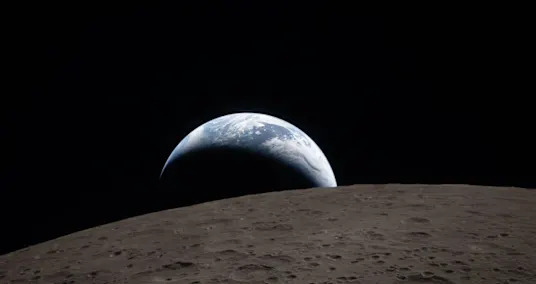
Particles from Earth’s atmosphere have been carried into space by solar wind and have been landing on the moon for billions of years, mixing into the lunar soil, according to a new study.
The research sheds new light on a puzzle that has endured for over half a century since the Apollo missions brought back lunar samples with traces of substances such as water, carbon dioxide, helium and nitrogen embedded in the regolith — the moon’s dusty surface layer.
Early studies theorized that the sun was the source of some of these substances. But in 2005 researchers at the University of Tokyo suggested that they could have also originated from the atmosphere of a young Earth before it developed a magnetic field about 3.7 billion years ago. The authors suspected that the magnetic field, once in place, would have stopped the stream by trapping the particles and making it difficult or impossible for them to escape into space.
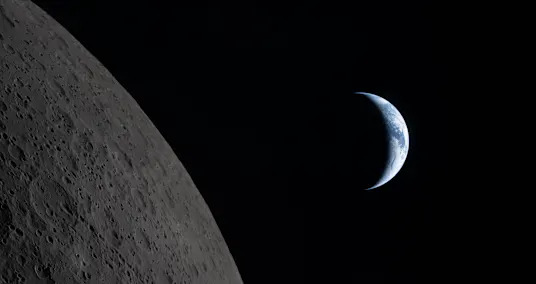
Now, the new research upends that assumption by suggesting that Earth’s magnetic field might have helped, rather than blocked, the transfer of atmospheric particles to the moon — which continues to this day.
“This means that the Earth has been supplying volatile gases like oxygen and nitrogen to the lunar soil over all this time,” said Eric Blackman, coauthor of the new study and a professor in the department of physics and astronomy at the University of Rochester in New York.

“It has long been thought that the Moon initially formed from an asteroid impact to the proto-Earth, during which there was a lot of initial mixing of such volatiles from Earth to moon,” he added via email. “Our results show that there is still volatile sharing, even over billions of years.”
The presence of useful elements such as oxygen and hydrogen on the moon’s surface could be of interest for lunar exploration.
“Lunar missions, and ultimately lunar colonies that might potentially arise someday, would likely have to have self-sustaining resources that do not need to be carried from Earth,” Blackman said.
“For example, people have studied how they might process water from lunar regolith and extract hydrogen and oxygen to make fuel. There are also studies of ammonia-based fuel which would take advantage of the nitrogen carried onto the moon by, and in the solar wind. So, this material carried by the solar wind goes into the soil and becomes part of the local resource that such innovations could exploit.”

A valuable chemical record
For the new study, the researchers used computer simulations and tested two scenarios. One had strong solar wind — a high-speed stream of particles coming from the sun — and no magnetic field around Earth. The other had weaker solar wind and a strong magnetic field around Earth. The scenarios roughly correspond to an ancient and a modern state of our planet. The modern Earth scenario turned out to be the most effective at transferring fragments of Earth’s atmosphere to the moon.
Researchers then compared the outcomes against data obtained directly from lunar soil analysis in previous studies.
“We used lunar samples brought to Earth by the Apollo 14 and 17 missions to validate our results,” said Shubhonkar Paramanick, a graduate student in the department of physics and astronomy at the University of Rochester. Paramanick was the lead author of the study, which published in December in the journal Nature Communications Earth & Environment.
“We have this solar wind coming onto the terrestrial atmosphere, and then the terrestrial atmosphere leaking away. So, we tried to determine what the mixing ratio of this mixture would be, or distinguish which particles are of solar origin and which of terrestrial origin,” he added.
Earth’s magnetic field is generated by electrical currents produced by the motion of molten iron and nickel in the planet’s liquid outer core. It extends far into space, forming a shield that deflects much of the solar wind, which would otherwise erode the atmosphere.
When the magnetic field interacts with the solar wind, it creates a magnetosphere — a comet-like structure with a compressed front and a long tail. When particles from solar wind are funneled along the lines of the magnetosphere near the poles, we get auroras, also known as the northern and southern lights.

The shape of the magnetosphere explains why solar wind can strip away some particles in Earth’s atmosphere and guide them out into space. It also allows for a higher fraction of Earth’s atmosphere to be carried to the moon than in the unmagnetized, or ancient Earth model, according to Blackman.
“The magnetic field is not purely protective for two reasons: It has a pressure to it, which somewhat inflates the atmosphere of Earth, giving the solar wind a bit more access to the atmosphere,” he said. “And when the Moon is in its full-moon phase of its orbit, it passes into a region called the ‘magnetotail’ where the magnetic field opens a channel that allows the blown atmosphere material to take a more direct path to the Moon.”
The moon passes through the magnetotail for a few days each month, and the particles land on the lunar surface where they embed in the soil because the moon lacks an atmosphere to block them.
Understanding the history of this interaction between the moon and Earth is important because it provides a valuable chemical record, or information about Earth’s ancient atmosphere that could be contained in the lunar soil, the study argues. The composition of the atmosphere, Blackman said, is connected to the evolution of life at different stages of Earth’s history.

A new perspective
Kentaro Terada, a professor of isotope cosmochemistry and geochemistry at Japan’s Osaka University, said he was delighted that his observations have been theoretically corroborated. Terada led a 2017 study that showed how solar wind and Earth’s magnetic field have transported oxygen to the moon, but he was not involved with the new research.
“It has long been recognized that Earth and moon have co‑evolved physically since their formation,” he said in an email. The discovery of lunar meteorites and the observation of particle streams from Earth carried by solar wind reveal a new perspective: “the two bodies have also influenced each other chemically — a kind of material exchange,” he explained, adding that the paper is “highly exciting in its comprehensive discussion of Earth’s history.”

The moon holds clues to the history and evolution of Earth, and this new study reinforces that notion, according to Simeon Barber, a senior research fellow at the Open University in the UK, who was not involved with the work.
The study is also timely, he added, due to the recent acquisition of new samples of young lunar soil by China’s Chang’e-5 mission in 2020 as well as the first samples from the lunar far side by Chang’e-6 in 2024, which offer the opportunity to test the findings further.
Additionally, Barber said, the work will inform the interpretation of results from upcoming lunar robotic landers capable of measuring the volatile elements in the lunar regolith directly.
For more CNN news and newsletters create an account at CNN.com
NEUESTE BEITRÄGE
- 1
 Most loved Fish Dish: What's Your Sea Pleasure?01.01.1
 - 2Feeling wonder every day improves our health. Here’s how to do it.19.12.2025
- 3'You're no longer my sister' - rows erupt as war divides Iranian families31.03.2026
- 4Holden Commodore Turbo BT1 Police Interceptor Offered for Sale in Australia26.12.2025
- 5Factbox-Artemis II crew includes first woman, Black astronaut and Canadian ever flown to moon01.04.2026




Ähnliche Artikel
- Artemis 2 captures historic 'Earthset' photo | Space photo of the day for April 7, 202607.04.2026
- Tesla Germany Registrations Quadruple to 9,252 Vehicles in Best March Ever07.04.2026
- What's going on with Katseye? The Manon Bannerman hiatus drama, explained.07.04.2026
- Two IDF officers, civilian face indictment in alleged Gaza aid-truck smuggling scheme07.04.2026
- West Palm Beach Shorecrest, renderings of downtown waterfront condo07.04.2026
- Artemis II astronauts make long-distance call to the space station as they head home from the moon07.04.2026
- Tuesday, April 7. Russia’s War On Ukraine: News And Information From Ukraine07.04.2026
- The Eastern Bongo, Kenya’s Rare Forest Antelope on the Brink07.04.2026
- U.K. blocks Kanye West from entering Britain to headline now canceled festival: What led to the ban07.04.2026
- Russia confirms 16 Cameroonian soldiers killed in Ukraine war07.04.2026
- First Phosphate advances battery-grade phosphate project as analysts highlight strategic Federal support07.04.2026
- After fleeing past Hezbollah fighting, some Israelis on northern border vow to stay07.04.2026
- 'Unreal' solar eclipse: Artemis 2 crew just saw one of the rarest sights in spaceflight history07.04.2026
- Chinese construction workers in Israel: 'I’d rather be bombed than live in poverty'07.04.2026
- Broken toilet, T-shirts on windows and collecting saliva: The weirdness of daily life aboard Orion07.04.2026
- Czech Republic caps fuel prices amid Iran war energy crisis07.04.2026
- NASA releases stunning new images captured by the Artemis II moon mission, including 'Earthset' and a solar eclipse from space07.04.2026
- Amid Iran war, 53 of Israel's future scientists showcase projects in Jerusalem contest07.04.2026
- Iranian-linked drone attack kills Kurdish couple in northern Iraq07.04.2026
- Thousands of small fish defy gravity to climb Congo waterfall07.04.2026