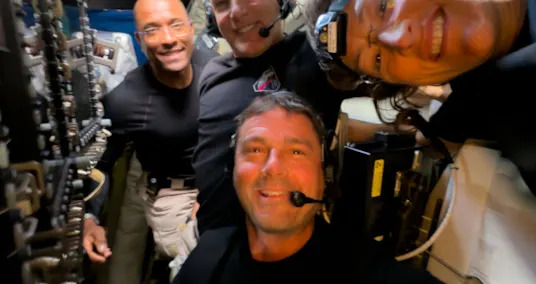
Four astronauts are now en route home from the International Space Station, marking the first time NASA has brought a crew home prematurely amid a health concern. And their unprecedented early departure leaves behind a bare-bones staff to look after the outpost.
Only three people remain on the orbiting laboratory: Roscosmos cosmonauts Sergey Kud-Sverchkov and Sergei Mikaev of Russia and NASA astronaut Chris Williams.
The four returning astronauts climbed aboard their SpaceX Crew Dragon capsule on Wednesday afternoon and, just before 3:30 p.m. ET, closed the hatch between the spacecraft and the International Space Station in preparation for their departure.
The Crew Dragon capsule then left the station at 5:20 p.m. ET.
It’s a less-than-ideal scenario. NASA has repeatedly signaled that keeping the ISS fully staffed is a top priority, as the agency aims to maximize the amount of scientific research it can conduct on the aging station before it’s permanently retired early next decade.
NASA’s new administrator, Jared Isaacman, made the decision last week to bring the four-person crew home early when the agency canceled a January 8 spacewalk slated to be carried out by American astronauts Mike Fincke and Zena Cardman.
“For over 60 years, NASA’s set the standard for safety and security in crewed spaceflight,” Isaacman said during a news conference last week. “In these endeavors, including the 25 years of continuous human presence on board the International Space Station, the health and the well-being of our astronauts is always and will be our highest priority.”

Fincke and Cardman, along with astronaut Kimiya Yui of the Japan Aerospace Exploration Agency, or JAXA, and Roscosmos cosmonaut Oleg Platonov, are part of the Crew-11 mission that’s leaving the space station. NASA did not say which crew member is experiencing a medical concern — nor did the space agency provide any details about the nature of the condition, citing privacy concerns. However, NASA has said the affected astronaut is in stable condition.
“Everyone on board is stable, safe, and well cared for,” Fincke confirmed in a statement posted to LinkedIn. “This was a deliberate decision to allow the right medical evaluations to happen on the ground, where the full range of diagnostic capability exists. It’s the right call, even if it’s a bit bittersweet.”
The Crew-11 team is slated to splash down in the Pacific Ocean aboard the Crew Dragon capsule around 3:40 a.m. ET Thursday.
Meanwhile, NASA is working to expedite the launch of a replacement crew, called Crew-12, which originally had been slated for mid-February.
What an understaffed ISS means
The space station hasn’t had such a small crew on board in years. However, during a news conference last week, Amit Kshatriya, NASA’s associate administrator, noted that it’s not unprecedented.
Before SpaceX began routinely flying its Crew Dragon capsule on staffing rotation missions to the space station in 2020, NASA had to purchase seats on Russia’s Soyuz capsule for rides to the outpost for nearly a decade after the Space Shuttle was retired in 2011.
“The crew on board, both Russian and American, are well trained to operate in the environment that they’re in, and can operate the nominal systems, the nominal research, per the plan, until their crewmates arrive,” Kshatriya said, using the spaceflight term “nominal” to refer to normal operations.
Still, the remaining crew members will likely need to leave some tasks unattended. For example, Kshatriya acknowledged, the trio will not be able to carry out the spacewalk that Fincke and Cardman had been slated to execute.

The American duo had been tasked with exiting the space station to prepare its exterior for the installation of new solar panels, which provide the outpost with power.
Delays installing the solar panels are not expected to create any urgent issues as the new hardware was intended to give the space station a power boost for expanding activity on board, Kshatriya said.
As things stand, the outpost does not need additional power for baseline operations, and there’s “plenty of margin,” Kshatriya noted.
Still, attempting to maintain the space station with only three crew members on board does have its challenges and risks, according to Garret Reisman, a former NASA astronaut who himself was part of a three-person crew alongside two Russians at the orbital outpost more than a decade ago.
“If I was going to put my finger on one thing that is significantly increased risk — it would be if something breaks on the outside,” Reisman told CNN in a Tuesday phone interview.
For example, should an issue arise on the exterior of the US side of the space station — such as an electrical switching unit suddenly breaking — Williams would not be able to conduct a spacewalk to fix the issue on his own.
Likely, one of his Russian colleagues would have to use an American suit and attempt to aid him on such an excursion, possibly with little training.
Such an emergency scenario is highly unlikely, Reisman noted, but it highlights why NASA typically does not like to bring an ISS crew home until a replacement crew is already in place.
Why NASA wants the ISS fully staffed
The US agency has long signaled that it wants to avoid leaving the space station understaffed for a variety of other reasons.
Isaacman, a billionaire and private astronaut, has signaled that he considers novel research on the orbiting laboratory to be an urgent priority. Such work, Isaacman has said, can help pave the way for new, commercial space stations that can replace the craft.
NASA has long hoped that private-sector companies would build space stations in low-Earth orbit so that the space agency can focus on its efforts exploring deeper into the solar system.
“I, like a lot of space enthusiasts, dream of the day where we have multiple commercial space stations in low-Earth orbit,” Isaacman said during a confirmation hearing in December. “But I think in order for that to be a financially viable model, we have to absolutely maximize the remaining life of the International Space Station — get the highest potential science and research to the space.”

NASA says a robust crew presence is crucial for getting the most value and productivity onboard the orbiting laboratory — which costs about $3 billion per year to operate.
The federal agency has in prior years taken great pains to ensure the space station has about seven or more astronauts on board at all times.
For example, in 2024, two NASA astronauts were slated to spend just a week on the space station. But when NASA found that their capsule malfunctioned and would not be safe for the return trip, the space agency opted to leave the duo — astronauts Butch Wilmore and Suni Williams — at the outpost for nine months in order to maintain staffing levels.
“Operating ISS is a complicated task and has been for the past 25 years,” Kshatriya said during last week’s news conference. “What we are reminded of every day is the unforgiving nature of human spaceflight.”
As for Chris Williams, he may have a lonelier time with the entire US portion of the space station all to himself.
“It’s nice to have another American, but Chris spent a lot of time with his Russian crewmates during training, and I’m sure they’ve got a good relationship,” Reisman said.
Relations between the US and Russia have grown notably tenser in the decade since Reisman spent months alone with his Russian crewmates, he noted.
“But by and large, they’re kind of ignoring the geopolitical situation. It’s kind of like Thanksgiving dinner: You just don’t talk about politics or religion,” Reisman said with a laugh.
Sign up for CNN’s Wonder Theory science newsletter. Explore the universe with news on fascinating discoveries, scientific advancements and more.
For more CNN news and newsletters create an account at CNN.com
NEUESTE BEITRÄGE
- 1
 Tire Brands for Senior Drivers: Guaranteeing Security and Solace05.06.2024
 - 2Doctor's orders? ‘Belly laugh at least two to five days a week'21.12.2025
- 3Figure out how to Guarantee Your Dental Embeds Endure forever19.10.2023
- 4Select Your Go-To Bluetooth Earphones06.06.2024
- 5Tata Motors, BMW among automakers set to raise prices in India27.03.2026



Ähnliche Artikel
- Artemis 2 captures historic 'Earthset' photo | Space photo of the day for April 7, 202607.04.2026
- Tesla Germany Registrations Quadruple to 9,252 Vehicles in Best March Ever07.04.2026
- What's going on with Katseye? The Manon Bannerman hiatus drama, explained.07.04.2026
- Two IDF officers, civilian face indictment in alleged Gaza aid-truck smuggling scheme07.04.2026
- West Palm Beach Shorecrest, renderings of downtown waterfront condo07.04.2026
- Artemis II astronauts make long-distance call to the space station as they head home from the moon07.04.2026
- Tuesday, April 7. Russia’s War On Ukraine: News And Information From Ukraine07.04.2026
- The Eastern Bongo, Kenya’s Rare Forest Antelope on the Brink07.04.2026
- U.K. blocks Kanye West from entering Britain to headline now canceled festival: What led to the ban07.04.2026
- Russia confirms 16 Cameroonian soldiers killed in Ukraine war07.04.2026
- First Phosphate advances battery-grade phosphate project as analysts highlight strategic Federal support07.04.2026
- After fleeing past Hezbollah fighting, some Israelis on northern border vow to stay07.04.2026
- 'Unreal' solar eclipse: Artemis 2 crew just saw one of the rarest sights in spaceflight history07.04.2026
- Chinese construction workers in Israel: 'I’d rather be bombed than live in poverty'07.04.2026
- Broken toilet, T-shirts on windows and collecting saliva: The weirdness of daily life aboard Orion07.04.2026
- Czech Republic caps fuel prices amid Iran war energy crisis07.04.2026
- NASA releases stunning new images captured by the Artemis II moon mission, including 'Earthset' and a solar eclipse from space07.04.2026
- Amid Iran war, 53 of Israel's future scientists showcase projects in Jerusalem contest07.04.2026
- Iranian-linked drone attack kills Kurdish couple in northern Iraq07.04.2026
- Thousands of small fish defy gravity to climb Congo waterfall07.04.2026